Facilities Maintenance Standards
Overview of the Facilities Maintenance Standards
To fulfill the Rule R23-3 mandate for facility management, state agencies and institutions must comply with the adopted Facilities Maintenance Standards. The purpose of these standards is to outline the minimum requirements for maintaining state-owned facilities and infrastructure to maximize their usefulness and cost-effectiveness, thereby enhancing the quality of life for Utah state employees, citizens, and visitors.
Compliance with both Rule R23-3 and the Facility Maintenance Standards is mandatory for all agencies and institutions, and all are subject to audit by the Division of Facilities Construction and Management (DFCM). Furthermore, all state facilities must adhere to adopted editions of the International Building Code, International Fire Code, OSHA, and UOSH.
Key components of the Facilities Maintenance Standards include:
- Documentation and Reporting: Agencies must maintain as-built drawings and O&M manuals. They are required to report current and accurate O&M costs annually and undergo a comprehensive Facility Condition Assessment every five years to quantify and prioritize deferred maintenance and capital renewal needs.
- Maintenance Management: Agencies must utilize a Computerized Maintenance Management System (CMMS) for tracking equipment data, logging corrective work orders, managing maintenance backlogs, and automating preventive maintenance schedules for major systems like chillers, boilers, and air handlers.
- System-Specific Requirements: The standards detail specific maintenance and inspection frequency for critical building systems, including:
- Life Safety: Regular inspection and maintenance of elevators, fire protection equipment (sprinklers, extinguishers), and uninterruptible power supply (UPS) systems.
- Mechanical/Electrical: Daily checks for boilers, quarterly leak checks for refrigerant systems, and biennial thermal-scan testing for all electrical panels and transformers.
- Inspections and Audits: Facilities are required to undergo a detailed and comprehensive maintenance audit at least every two years. They must also perform mandatory inspections following significant natural events, such as an earthquake, to assess and report any structural or mechanical damage.
Facilities Maintenance Standards
Review the complete Facilities Maintenance Standards to understand the requirements for maximizing the usefulness, cost-effectiveness, and quality of state-owned facilities and infrastructure for Utah employees and citizens. Click the button below to read the full details.
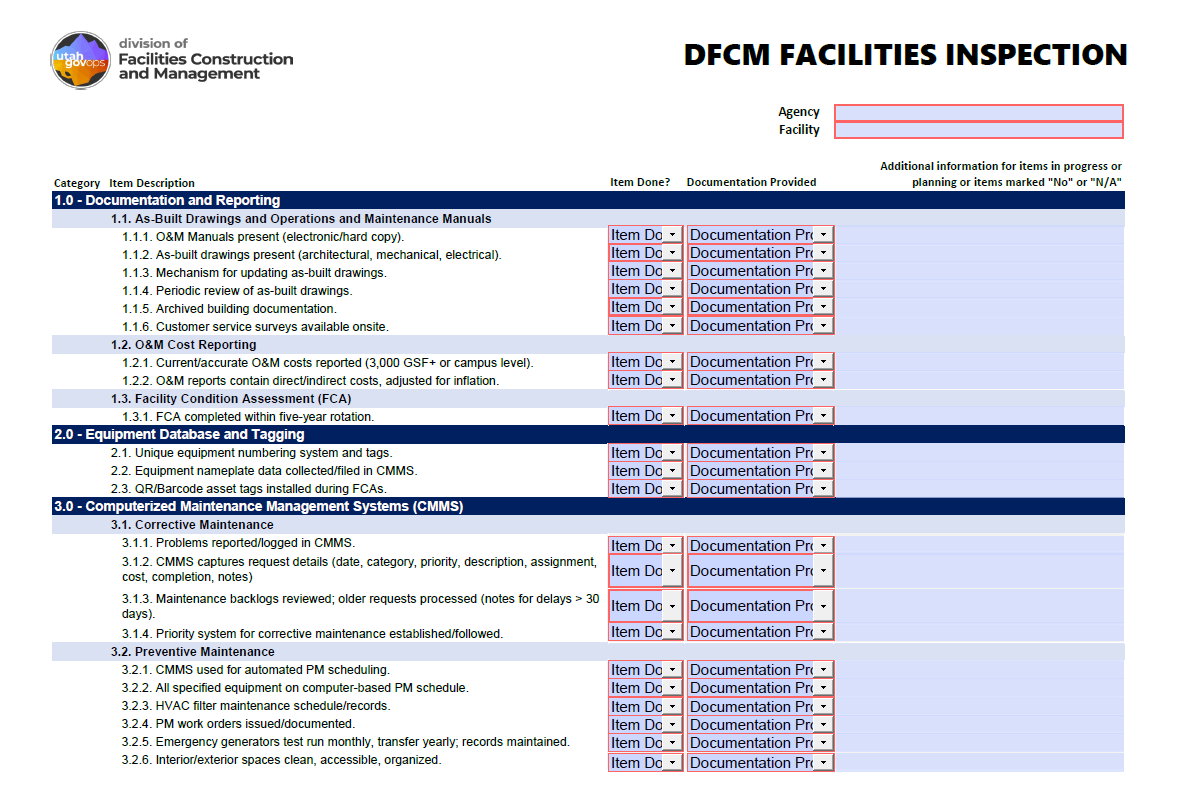
Facility Audit Checklist
Discover the detailed steps and criteria used during a Facility Audit by reviewing the official checklist. This assessment is key to quantifying and prioritizing the deferred maintenance and capital renewal needs for state buildings. Click the button below to view the checklist.
Other Resources
Seismic Risk Analysis Checklist
The Seismic Risk Analysis Checklist, a Structural Risk Evaluation Questionnaire, assesses 14 construction, age, and location risk factors for properties in high-activity seismic regions.


Rapid Visual Screening of Buildings for Potential Seismic Hazards: A Handbook, Third Edition (FEMA 154 Protocol)
This handbook provides the methodology for the Rapid Visual Screening (RVS) Assessment, a quick, preliminary evaluation used during routine Facility Condition Assessments (FCAs) for buildings over 20 years old. It helps identify potentially vulnerable structures that require a more thorough seismic review.

Post-Earthquake Building Safety Assessment (ATC-20)
The ATC-20 forms are standardized tools for immediate post-earthquake evaluation of buildings to determine safety and re-occupancy status.
The Rapid Evaluation is a quick assessment of visible damage, resulting in an Inspected (Green), Restricted Use (Yellow), or Unsafe (Red) placard.